comment [326]
- From trax on 06-04-2012 at 13:28:12
@Ademir / Brazil: Obrigado. Estou feliz que você gosta deste projeto.
IP: n/a
This is a very simple IR light dimmer that you will wish to have sooner or later, especially those who are lazy enough to get up and turn off the lights. There are two versions of PCB for two sizes of capacitors, so PCBs are: 32.5 x 26.5mm and 28.5 x 27mm.
You can download the project files at the bottom of this page by clicking on red "download" button.
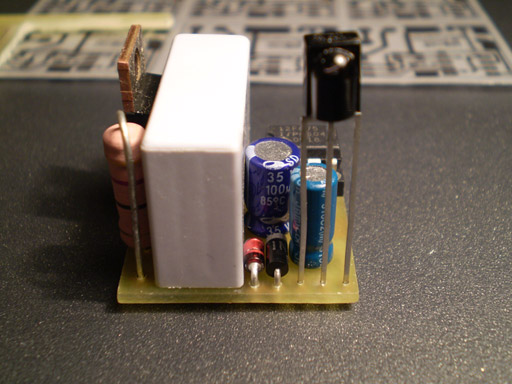
Features of current beta version of firmware:
- Soft start (gradually turning on the light bulb)
- Soft down (gradually turning off the light bulb)
- Learning IR codes from RC5 and NEC remotes
- Dimming in 10 levels by using only IR remote
- Previous dimm-level remembering when operating with remote
- Sleep timer in duration of 1.6min for 60Hz version and 2min for 50Hz version
- ON/OFF control with wall pushbutton
Dimmer is connected to existing home wiring installation inside a junction box, which is usually located above the light switch. In order to properly connect the dimmer to installation one should follow the schematics provided for that purpose. If connected differently there is a very big chance of some freaky side effects such as burned PIC microcontroller, serious fire and who knows what else.
Learning remote control IR codes (programming procedure)
After connecting dimmer to installation you must program the remote control buttons. Here is how to do that:
1. Hold the wall pushbutton for 11 sec so that dimmer can enter programming mode. After those 11 sec, LED will start to blink fast, and light will dimm to third (3.) level. Now you have 11 sec to complete the programming sequence:
2. Press the first button on your remote that will increase light level or turn on the light when it is turned off (ON/UP)
3. Press the second button on your remote that will be used to decrease the light level (DOWN)
4. Press the third button that will be used for activating/deactivating sleep mode (SLEEP)
5. Finally, press the fourth button that will be used to turn off light completely (OFF)
During programming, both the light bulb and LED will blink to confirm IR code reception. If your remote control does not have all 4 buttons that you can use, you can repeat previous button but that will cancel out some features. For example, if your remote has only two buttons (A and B), and if during programming you press: A A A B, that means that key A will be used for ON/UP function, and key B will be used to completely turn off the light. If you choose combination A B B B, it means that the key A will be again used for ON/UP function, and key B will be used to decrease light level (it will also turn the light off completely in 10 button presses - until zero level).
Programming notice: If during programming, you notice that LED blinks even when you don't press any buttons on your remote control, it is probably because you used TSOP11xx instead of TSOP17xx receiver module. In that case, you will probably not be able to program your dimmer properly.
If you are not satisfied with your choice of remote controller buttons, you can repeat the learning procedure as much as you like.
If you are planning to use your TV's remote controller, you should probably choose those teletext buttons: red, green, yellow and blue to avoid, for example, switching channels when operating the dimmer.
Sleep timer
Sleep timer can be activated by a bit longer wall-pushbutton press, more than 1.8 sec to be precise, or by pressing the appropriate button on the remote controller. Sleep timer cancellation is accomplished just like the activation. It is possible to increase/decrease the light level when sleep timer is active. Dimmer will automatically set the light level to six (6) when entering the sleep mode, but only if previous level was greater than 6.
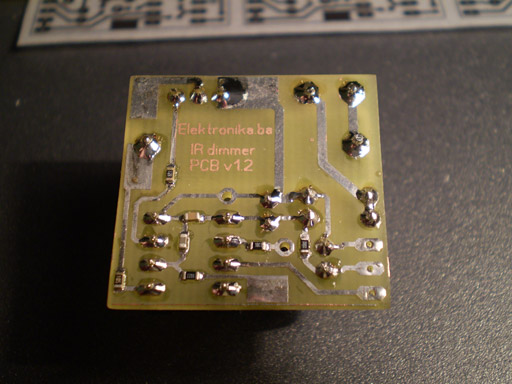
Important notice: This device is connected to mains power line, so it requires a lot of respect. If you are not sure in what you are doing, you better leave the installation part to the experienced electrician.
Dimmer in operation:
Note: Dimmer works better with TIC206 rather than TIC216!
Author (sent by): Trax
Download counter: 55,274
Rating: 
 (2.99, votes 8092)
Vote: 

Date: 07-02-2009
Lokalna verzija ove stranice: IR dimmer svjetla v1
Je li iko uspio napraviti zastitu od pregorijevanja TRIAC-a u slucaju kratkog spoja na
potrosacu? Osiguraci sa brzim djelovanjem nisu dovoljno brzi.
IP: 89.146.158.92
@Ademir / Brazil: Obrigado. Estou feliz que você gosta deste projeto.
IP: n/a
Este projeto é muito bom. Aqui utilizei um TIC106 e funcionou direitinho. No lugar do Tsop17xx
utilizei o BRM1030 e funcionou também (era o que eu possuía). Aqui a rede é 110AC/60Hz.
Parabéns pelo projeto.
IP: 201.82.249.190
Upravo to sam i mislio, stavis jedan kraj sekundara na GND od PIC-a, a drugi preko tog velikog
otpornika na PIC i to je to. Javi sta se desilo...
IP: n/a
Ok. Hvala puno na strpljenju. Javicu se...
IP: n/a
Ako ne uspije to sa transformatorcicem (moze i 220-12), jer ima ovaj megaomski predotpor javi
mi pa da vidim mogul sta izvest...
IP: n/a
Mislis da jedan kraj trafoa vezem na masu PICa a sa drugog da uzmem detekciju? Uh kad bi to
resilo stavio bih neki mini trafo...
IP: n/a
Nisam siguran kako to rijesiti, jer PIC generise interrupt kada sinusoida krene da opada iz
nule, pa onda kada raste od nule prema maksimumu. Jedna stvar je sigurna, a to da ti treba
galvanska izolacija od mreznog napona. Preko opto-kaplera se nece moci rijesiti jer ne mozes
napraviti i pozitivan i negativan 5V impuls... ili mozes? Drugo, mozda da stavis transformator
220-5V (eksperimentalno) i da preko njega uzimas taj signal za sinrhonizaciju.
IP: n/a
Aha, sad sam video tvoj post. Imas predlog kako da resim to?
IP: n/a
NISAM STAVIO R4 nego direktno. Da nije to??? Ili da probam TIC216 umesto BT139. Mada sumnjam da
je to.
IP: n/a
You can log-in on forum link: Login page. After logging-in, return to this page and click refresh in your browser.
phone radio fm amplifier ir mhz transmitter sms tv bug antena light gsm alarm prekidac pojacalo detektor sensor bubica audio battery pic detector telephone telefon atmel senzor switch led predajnik